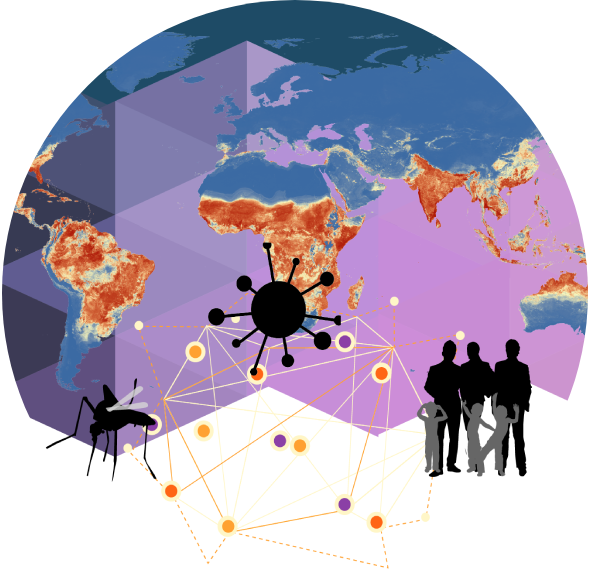
Conceptual Background
From the applied science scope
Understanding the dynamics of viruses considered a threat to global health is essential to achieve the World Health Organization’s strategic plan to improve pandemic preparedness (1). To further improve disease control strategies, it is crucial to bridge science with public health through ‘cross-sectoral collaborations and data sharing’ (2).
Under a ‘One Health’ approach of “multiple disciplines working together to attain better health for people, animals and the environment” (3), specific emphasis has been placed on investigating disease ecology from different perspectives, to both determine sources of infection, and develop surveillance models to monitor interacting animal and human populations considered most vulnerable (4-6).
Within high-risk areas, social inequalities also tend to exacerbate the burden of viral diseases (7, 8), yet the societal causes underlying disease transmission are often overlooked (9). Thus, the study of viral disease dynamics should be undertaken within specific ecological and social settings.
From the basic science scope
Convergence defines the occurrence of common evolutionary and epidemiological trends in otherwise unrelated viruses (10-14).
Identifying molecular signatures of convergent evolution raises the possibility of predicting evolutionary trajectories that are a consequence of the adaption to specific ecological contexts (such as emerging viral outbreaks in human populations) (10-12, 14).
Convergence can also be identified as the occurrence of common features in independent viral epidemiological and evolutionary dynamics, as well as in comparable ecological and social factors that act as their drivers.
Genomic epidemiology and model-based approaches can be used together to explore evolutionary and epidemiological convergence. Linking diverse scientific scopes informed by multidisciplinary data can enhance disease surveillance systems, and yield comprehensive and scalable frameworks to control and predict the behaviour of current and future viral outbreaks.
Mexico as a Case Study

Mexico has been severely impacted by recent pandemic outbreaks (as highlighted by the 2009 influenza A pandemic and COVID-19) (8, 15). Mexico also ranks within the top five countries reporting the highest case numbers of endemic mosquito-borne (i.e., dengue and chikungunya) viruses (16, 17), with the southern region identified as a transmission hotspot for several epidemics (18, 19) (Gutierrez B, available as preprint here) (Gutierrez et al, 2023).
Given its social and ecological heterogeneity, Mexico poses a perfect case study to develop pilot surveillance programs that would: i) devise local strategies for disease prevention and control (linking into public health), ii) assess the feasibility and scalability of local strategies into general models (i.e., applicability in other populations and geographic locations), and iii) build local capacity to increase representation within a wider international scientific community.
What is "REEED-SOCIAL"?
“REEED-SOCIAL” (Red de Epidemiología genómica, Ecología y Evolución molecular para el estudio de Dinámicas virales en un contexto Social; SOCIAL NETWORK in English) stands for creating a ‘Network of Genomic Epidemiology, Ecology and Molecular Evolution for the study of Viral Dynamics within a Social Context’
See our Publications
Research Questions
Can molecular signatures of convergent evolution associated with adaptation in independent virus populations be used to identify common evolutionary trajectories that lead to the emergence of high-risk viral phenotypes/genotypes?
Do unrelated viruses circulating within shared ecological niches display similar trends in their evolutionary and epidemiological dynamics?
Is it possible to use evolutionary and epidemiological convergence as a proxy to predict outbreak dynamics, and further inform disease control strategies?
Are the proposed cohorts representative sample populations that can be used as sentinels to monitor viral emergence and spread within a broader context?
Is it possible to generalize local surveillance models to make them scalable? What are the key differences and similarities that need to be considered for scalability?
Our Goals
- To generate basic scientific knowledge on the feasibility of extrapolating evolutionary and epidemiological convergence to inform disease control strategies.
- To foster ‘cross-sectoral collaborations and data sharing’, placing genomic epidemiology within specific ecological and social settings.
- To devise deployable strategies for exploiting multidisciplinary data to inform the study of evolutionary and epidemiological dynamics in targeted viruses relevant to global health (20, 21).
- To promote scientific reproducibility by developing methods and computational pipelines for systematic, automated and scalable analyses.
- To implement small-scale regional pilot surveillance programs that will build upon model scalability strategies.
- To address critical questions on public health at a local scale using genomic epidemiology
- To improve resource and capacity availability/allocation in Mexico, promoting welfare and outbreak preparedness.
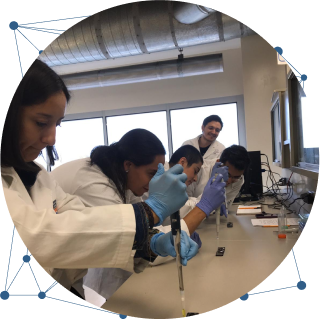
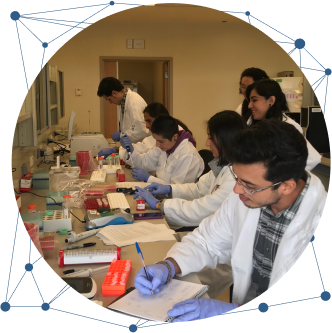
- To promote capacity building, achieved through teaching, mentoring and supervision.
- To develop educational programs with local communities, bringing awareness on viral outbreaks, as well as co-developing strategies to address societal issues within the scope of this project.
Activities
With the support of the “REEED-SOCIAL” data network, the project will place the study of disease evolution and dynamics within specific ecological and social contexts, using multiple-sourced data to inform multidisciplinary (phylodynamic and modelling-based) analyses. It will further address critical questions on public health using genomic epidemiology (18) and (Gutierrez B, in preparation).
Secondary outcomes of the project include novel data generation and synthesis, development of custom-made computational pipelines to enable automated analyses, capacity building under a ‘One Health’ approach
Planned Pilots
“REEED-SOCIAL” will also implement small-scale regional pilot surveillance programs, initially to be developed in Mexico as a specific case study region, where three independent cohorts will be studied: i) Hospitals, ii) Frontiers, and iii) Markets.
Hospitals involves a systematic sample allocation from hospitalized cases classified as ‘undiagnosed, severe suspected viral infections’, to be sequenced under a metagenomic approach. The goal is to detect unnoticed viruses circulating cryptically in hospitalized patients.
Frontiers involves an active health status monitoring of overlooked human populations involved in unregulated migration. The goal is to establish targeted virus surveillance, to identify changing social behaviours, and to explore how these may impact the spread of viral diseases across borders.
Markets involves targeted virus surveillance of both human and animals within densely populated city markets. The goal is to determine if the populations within these urban spaces can be used to monitor viral emergence and spread before widespread outbreaks occur within a city.
Our Research Approach
The core research approach comprises three collaborating operational units (OU) covering both public health and academic sectors in Mexico, UK and the USA. Each OU will coordinate different activities to generate, share and exploit multidisciplinary data applied to study convergence in viral dynamics.
COLLABORATORS
OU-1
‘Unit for Sampling and Sequencing’: this OU will establish a network for a systematic sample collection and allocation from different sources, to be further sequenced using different HTS technologies. Sequencing will target specific viruses that are considered a threat to global health (20, 21), and known to circulate in Mexico either endemically or seasonally.
OU-2
‘Unit for Genomic Evolutionary Analysis’: this OU will support the automated and scalable application of integrated methodologies through the development of computational pipelines. Publicly available and novel genomic data (direct output of the OU-1) will be periodically collated and analysed using tailor-made computational pipelines to investigate epidemiological and evolutionary convergence. Core methodology is based on molecular evolution, phylodynamics and genomic epidemiology tools.
OU-3
‘Unit for Analysis in Quantitative Data and Spatial Modelling’: this OU will comprehensively integrate OU-2’s output with modelling-based approaches, informed by diversely sourced multidisciplinary (climatic, demographic, epidemiological, ecological and social) data. Data will be used to test hypotheses on the social and ecological drivers of viral dynamics in Mexico, further exploring convergence, as in comparable disease trends and drivers. OU-3’s work involves close collaboration with experts in mathematical modelling, quantitative ecology, epidemiology and social anthropology.
Who are we?

Partner Institutions










Our Research Approach
OU-1
Dr. Miguel Garcia Knight
The University of California, San Francisco-USCFInstituto de Investigaciones Biomédicas, Universidad Nacional Autónoma de México (UNAM)
Prof. Carlos Arias
Instituto de Biotecnología, Universidad Nacional Autónoma de México (UNAM)Dr. Carlos Machaín Williams
Universidad Autónoma de Yucatán - Centro de Investigaciones Regionales 'Dr. Hideyo Noguchi'OU-2
Prof. Oliver Pybus
Department of Biology, ‘The University of Oxford’The Royal Veterinary College (RVC)
Dr. Simon Dellicour
Spatial Epidemiology Lab-Université Libre de Bruxelles FNRS BelgiumDr. Lucy Van Dorp
UCL Genetics InstituteOU-3
Prof. Kate Jones
The People and Nature Lab-UCLDr. Moritz Kraemer
Department of Biology, ‘The University of Oxford’Dr. Gerardo Suzán
Laboratorio de Ecología de Enfermedades y Una Salud,Universidad Nacional Autónoma de México (UNAM)
Key Partner Institutions
Instituto de Diagnóstico y Referencia Epidemiológicos “Dr. Manuel Martínez Báez” (InDRE-Ministry of Health Mexico/PAHO partner
Universidad Autónoma de Yucatán - Centro de Investigaciones Regionales 'Dr. Hideyo Noguchi'
Centro de Investigación en Enfermedades Infecciosas- Instituto Nacional de Enfermedades Respiratorias Mexico (INER)
Consorcio Mexicano de Vigilancia Genómica-CoViGen-Mex
Instituto de Biotecnología, Universidad Nacional Autónoma de México (UNAM)
Instituto de Ecología, Universidad Nacional Autónoma de México (UNAM)
Research Department of Genetics, Evolution and Environment (GEE), University College London
Get In Touch
References
1. WHO. 10 global health issues to track in 2021 2020 [Available from: https://www.who.int/news-room/spotlight/10-global-health-issues-to-track-in-2021].
2. Hill V, Ruis C, Bajaj S, Pybus OG, Kraemer MUG. Progress and challenges in virus genomic epidemiology. Trends Parasitol. 2021;37(12):1038-49.
3. WHO. One Health 2017 [Available from: https://www.who.int/news-room/questions-and-answers/item/one-health].
4. Grubaugh ND, Ladner JT, Lemey P, Pybus OG, Rambaut A, Holmes EC, et al. Tracking virus outbreaks in the twenty-first century. Nat Microbiol. 2019;4(1):10-9.
5. Holmes EC, Rambaut A, Andersen KG. Pandemics: spend on surveillance, not prediction. Nature. 2018;558(7709):180-2.
6. Aarestrup FM, Bonten M, Koopmans M. Pandemics- One Health preparedness for the next. Lancet Reg Health Eur. 2021;9:100210.
7. Vasylyeva TI, Liulchuk M, Friedman SR, Sazonova I, Faria NR, Katzourakis A, et al. Molecular epidemiology reveals the role of war in the spread of HIV in Ukraine. Proc Natl Acad Sci U S A. 2018;115(5):1051-6.
8. UCSF. Mexico's Response to Covid-19: A Case Study. 2021.
9. Weiss RA, McMichael AJ. Social and environmental risk factors in the emergence of infectious diseases. Nat Med. 2004;10(12 Suppl):S70-6.
10. B, Escalera-Zamudio M, Pybus OG. Parallel molecular evolution and adaptation in viruses. Curr Opin Virol. 2019;34:90-6.
11. Escalera-Zamudio M, Golden M, Gutierrez B, Theze J, Keown JR, Carrique L, et al. Parallel evolution in the emergence of highly pathogenic avian influenza A viruses. Nat Commun. 2020;11(1):5511.
12. Escalera-Zamudio M, Pond SLK, de la Vina NM, Gutierrez B, Theze J, Bowden TA, et al. Identification of site-specific evolutionary trajectories shared across human betacoronaviruses. bioRxiv. 2021.
13. Stern A, Yeh MT, Zinger T, Smith M, Wright C, Ling G, et al. The Evolutionary Pathway to Virulence of an RNA Virus. Cell. 2017;169(1):35-46 e19.
14. Avanzato VA, Oguntuyo KY, Escalera-Zamudio M, Gutierrez B, Golden M, Kosakovsky Pond SL, et al. A structural basis for antibody-mediated neutralization of Nipah virus reveals a site of vulnerability at the fusion glycoprotein apex. Proc Natl Acad Sci U S A. 2019;116(50):25057-67.
15. Mena I, Nelson MI, Quezada-Monroy F, Dutta J, Cortes-Fernandez R, Lara-Puente JH, et al. Origins of the 2009 H1N1 influenza pandemic in swine in Mexico. Elife. 2016;5.
16. Control) EECfDPa. Dengue worldwide overview 2022 [Available from: https://www.ecdc.europa.eu/en/dengue-monthly].
17. PAHO. Epidemiological Update for Dengue, Chikungunya and Zika in 2022 2022 [Available from: https://www3.paho.org/data/index.php/en/mnu-topics/indicadores-dengue-en/annual-arbovirus-bulletin-2022.html.
18. Castelán-Sánchez HG, Delaye L, Inward RPD, Dellicour S, Gutierrez B, de la Vina NM, et al. Comparing the evolutionary dynamics of predominant SARS-CoV-2 virus lineages co-circulating in Mexico. bioRxiv. 2022.
19. Dzul-Manzanilla F, Correa-Morales F, Che-Mendoza A, Palacio-Vargas J, Sanchez-Tejeda G, Gonzalez-Roldan JF, et al. Identifying urban hotspots of dengue, chikungunya, and Zika transmission in Mexico to support risk stratification efforts: a spatial analysis. Lancet Planet Health. 2021;5(5):e277-e85.
20. WHO. Ten threats to global health in 2019 2019 [Available from: https://www.who.int/news-room/spotlight/ten-threats-to-global-health-in-2019.
21. PAHO. As COVID-19 cases rise in the Americas, countries also face the threat of seasonal flu, hurricanes, PAHO Director says. 2022.